
Last updated September 20, 2026
Free on-site gate assessment - hinges, posts, and your LiftMaster or Nice gate operator checked before anything is quoted
The assessment is free and the quote is the invoice.


 Before
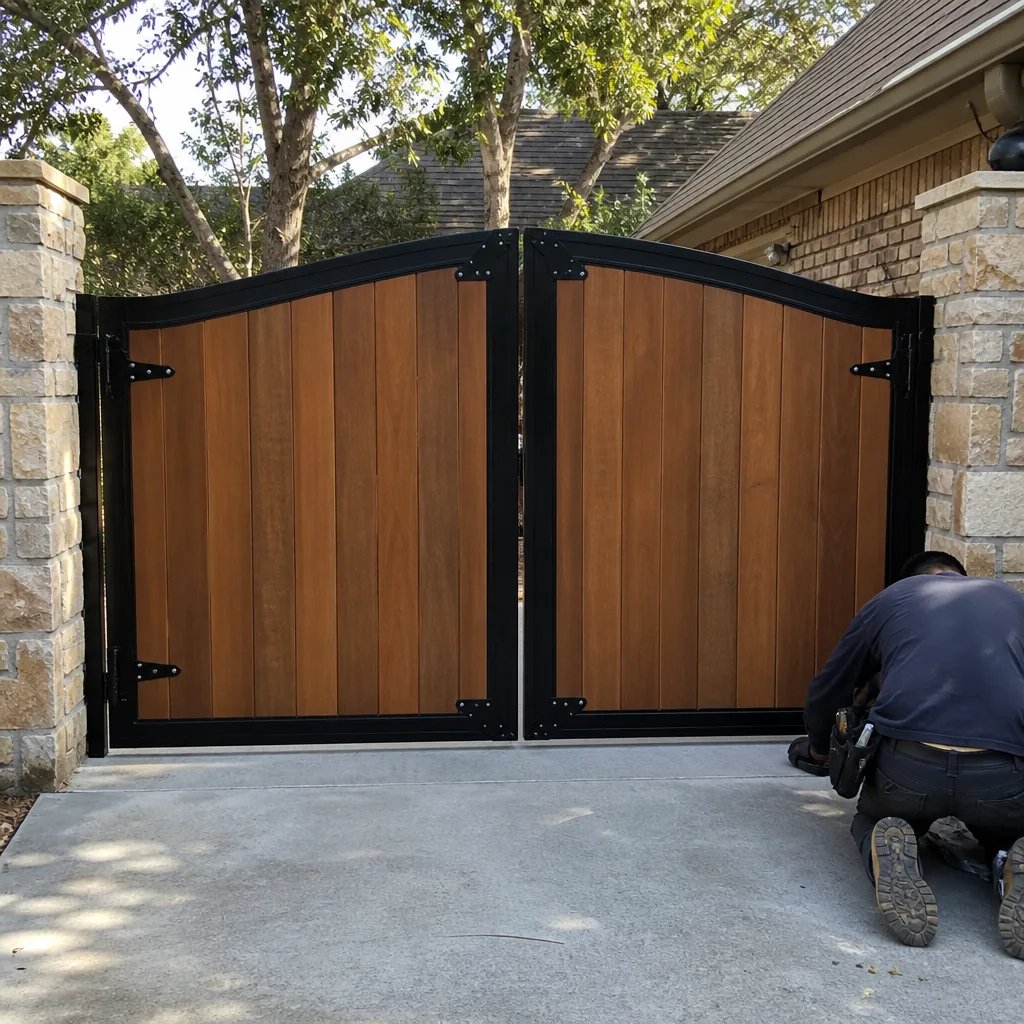 After
After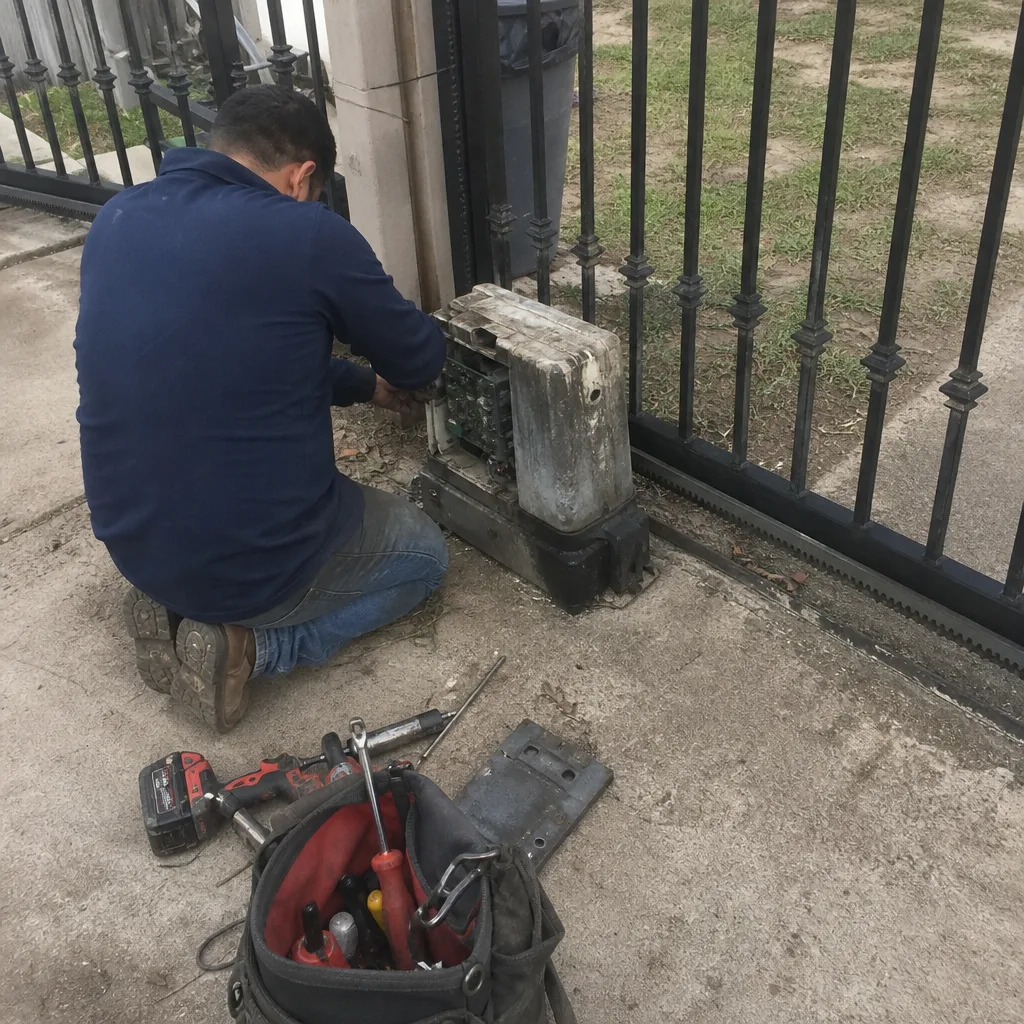 Before
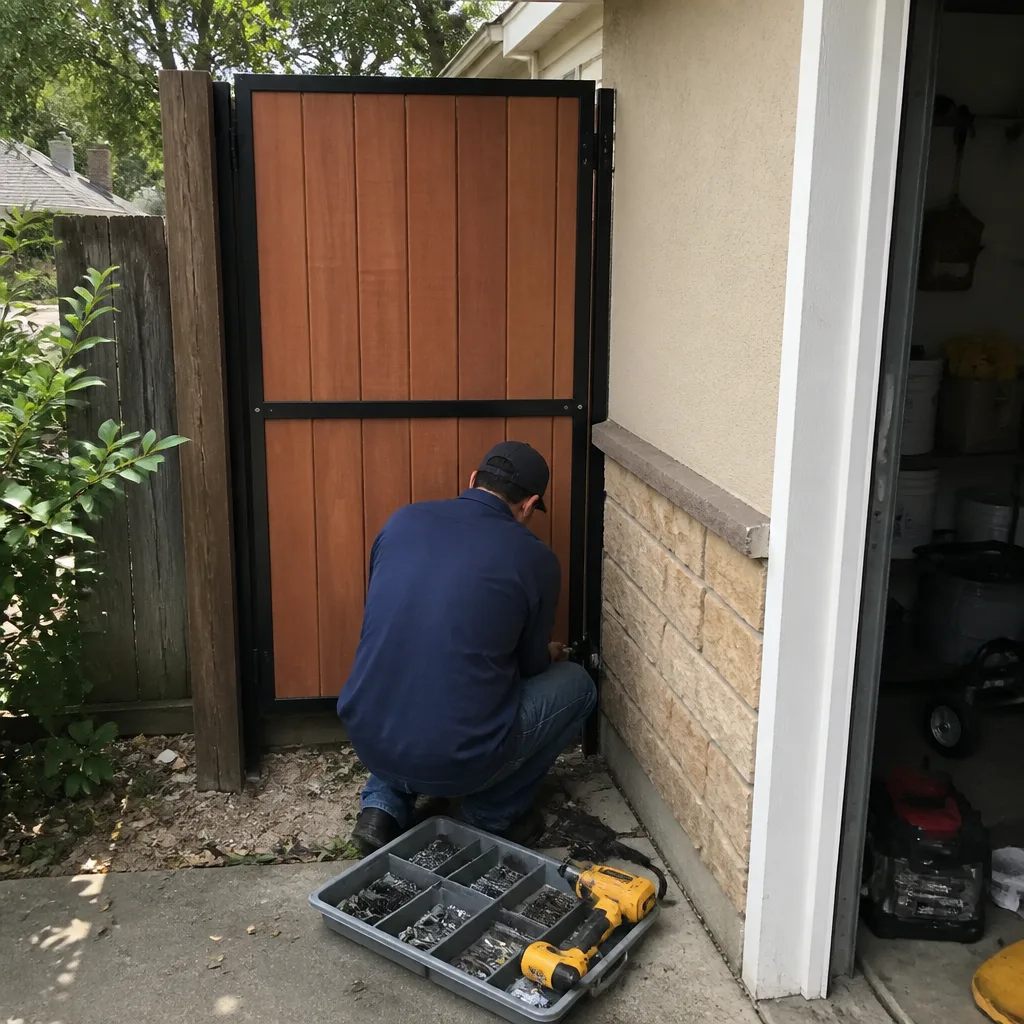 After
After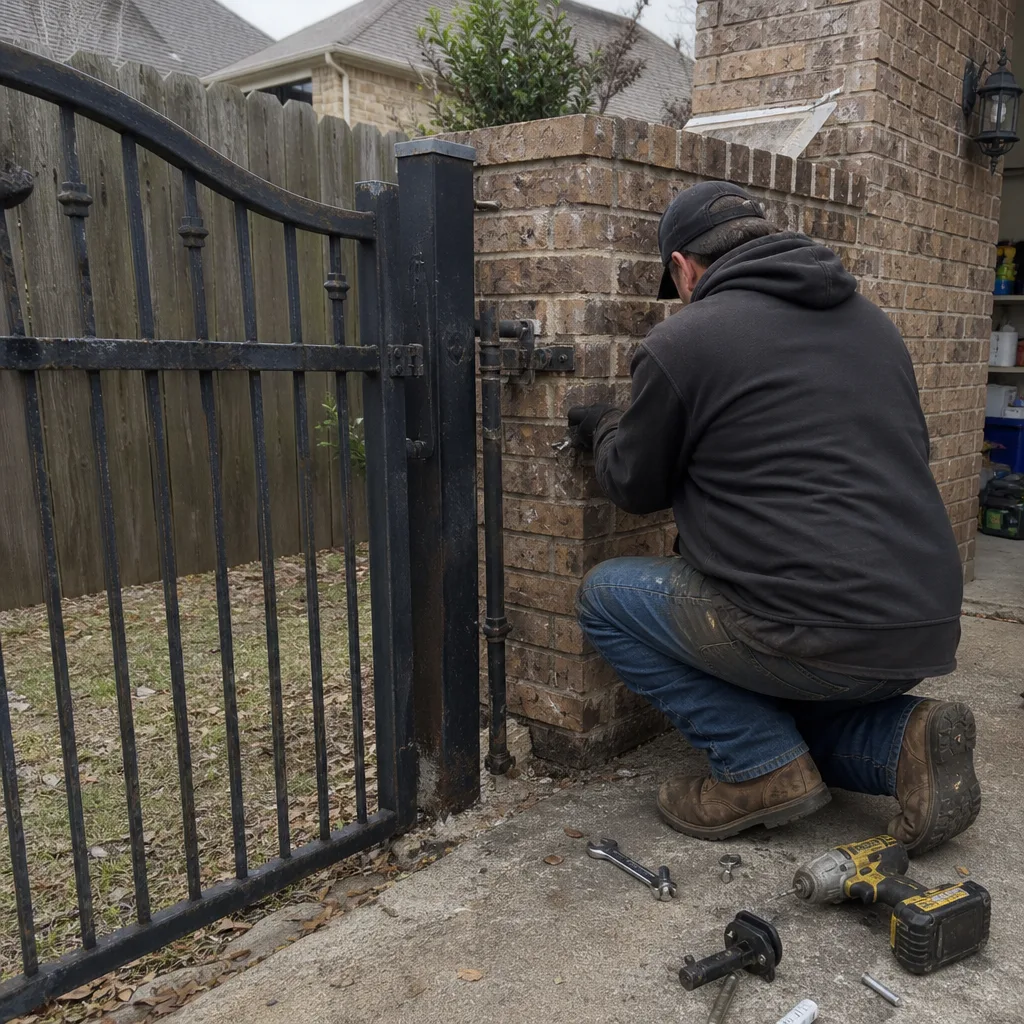 Before
 After
AfterGate Repair Permits, Codes & Inspections in TX: What You Need to Know
A permit isn’t usually required to repair a gate in Texas, but “usually” is doing heavy lifting in that sentence, and the cases where it is required are the same cases where the work is most expensive to undo. Most homeowners in Murphy and across Collin County assume gate work flies under the radar. That assumption holds for a broken hinge or a misaligned sensor. It collapses the moment the job touches structural footings, a new operator wired to a sub-panel, or a gate that an HOA architectural committee has already approved once and will review again. This guide walks the actual line: what needs a permit, what needs HOA approval, what needs neither, and how to document the work so it never comes back to bite you. For related reading, see our Gate Repair Warning Signs: A Murphy Homeowner’s Reference Guide.
Quick Answer
Repairing an existing gate in Texas usually requires no permit. The exceptions are structural work (new footings, post replacement, masonry columns), electrical work that connects to a branch circuit rather than an existing low-voltage outlet, and any installation governed by a local HOA covenant. For Murphy residents, the first call is to the City of Murphy Building Permits division, not the county, and not the HOA.
Table of Contents
- When a Permit Is Actually Required in Texas
- Murphy and Collin County: Who You Call First
- HOA Approval Is a Separate Process Entirely
- The Electrical Line: Low-Voltage vs. Branch Circuit
- Structural Thresholds: Footings, Posts, and Columns
- What Unpermitted Gate Work Does to an Insurance Claim
- How to Document a Repair So It Survives a Future Inspector
- Common Mistakes to Avoid
- When to Call a Professional
- Frequently Asked Questions
- The Bottom Line
BeforeAfterWhen a Permit Is Actually Required in Texas
Texas does not have a single statewide gate permit code. Residential construction permitting is delegated to municipalities, and most follow the International Residential Code (IRC) with local amendments. What that means in practice: a gate repair that alters nothing structural and touches no new electrical load is a maintenance activity, not a construction activity. You will not find a “gate repair permit” application in Murphy or any neighboring city. What you will find is that certain types of work involving gates trigger permits under other chapter headings: electrical, structural, and sometimes zoning.
The permit triggers that actually apply to residential gate work in Texas fall into three buckets:
- New permanent footings or post replacement. If a gate post is being set in concrete that did not exist before, or an existing footing is being cut out and re-poured, that is structural work. Most Texas municipalities require a permit for any structure attached to the ground by a footing deeper than 24 inches or bearing on a permanent foundation. A simple post re-set in an existing concrete pier does not. A new column for a wider driveway gate generally does.
- Electrical work beyond low-voltage replacement. Underground gate operators, keypads, and vehicle loop detectors that tie into a 120V branch circuit on a breaker panel require an electrical permit in most Texas cities. Replacing a swing arm operator that plugs into an existing outdoor GFCI outlet does not. The line is where the licensed electrician is required, and that line is the permit line.
- Anything that changes access or setback. In some Texas municipalities, moving the physical gate location, extending a driveway opening, or installing a new gate across an easement triggers a zoning review. This is less common in established suburban lots like those in Murphy, but it applies frequently in rural Collin County where driveway easements cross county drainage rights-of-way.
The pattern is consistent: the more the work resembles original construction, the more likely a permit attaches. The more it resembles fixing what was already there, the less likely. That principle is the single most useful test for any homeowner. Before buying hardware or scheduling a crew, ask whether the work changes the footprint, the foundation, or the electrical load. If the answer to all three is no, you are almost certainly in no-permit territory.
Murphy and Collin County: Who You Call First
Murphy operates its own building permits division under the City of Murphy, and it is the authority that matters for residential gate work inside city limits. Collin County does not issue building permits for incorporated cities. If you live within the Murphy city boundary, calling the county first wastes a step. Call the City of Murphy Building Permits office and describe the scope of the gate work. The person on the line will route you to the relevant trade review: electrical, structural, or zoning. In our experience in Murphy, the average permit question about gate work gets answered in a single phone call, and the staff are direct about what does and does not need paper.
Three scenarios in Murphy specifically:
- Standard gate repair in an existing single-family home. No permit. This includes hinge replacement, track adjustment, photo-eye realignment, and same-motor replacement. Murphy treats this as routine maintenance, same as replacing a water heater element.
- New automated gate with a 120V circuit run. Electrical permit required. The city reviews the circuit load, the disconnect location, and the wiring method. The gate operator manufacturer’s installation manual is accepted as the product listing, but the circuit work falls under NEC Chapter 3 and must be done by a licensed electrician, not a handyman.
- New masonry columns for a driveway gate on a corner lot. Permit required, and not just structural. Murphy zoning reviews corner-lot visibility triangles and setback offsets. A column that blocks a clear sight line at a street intersection will not pass.
For residents in unincorporated Collin County near Murphy, no city permit applies. County rules are looser but not absent. Collin County enforces on-site sewage and drainage rules, and any gate installation that alters drainage flow across a county easement can draw a notice. If your property receives county services rather than city services, the safest first call is to the Collin County Development Services desk, but be prepared for the answer to be “that’s not ours” for most ordinary gate repairs.
The practical sequence for a Murphy homeowner is: call the city first, describe the work, and keep a note of the name of the person you spoke with and the date. That call log is part of your documentation trail and costs nothing to create.
HOA Approval Is a Separate Process Entirely
This is the area where homeowners get blindsided, and it is the one with the least connection to actual construction law. An HOA architectural covenant operates as a private contract. It exists independently of city permitting. A city permit does not satisfy an HOA requirement, and an HOA approval does not satisfy a city permit requirement. They are two parallel tracks, and Murphy has a high concentration of HOA-governed subdivisions, which makes this distinction unusually relevant here.
Gate work that typically triggers HOA review in Murphy subdivisions:
- Any new gate at a driveway entrance. Most Murphy HOAs require architectural committee approval before a new driveway gate is installed, including the style, height, material, and color. Some require a drawn elevation or a photo mockup.
- Changing gate material or color. Even when the footprint is identical, swapping a wood gate for a steel gate or repainting from black to bronze can fall under covenant review. The standard HOA language is “material change to the exterior appearance,” and a gate is an exterior feature.
- Adding an operator box or keypad pedestal. Visible equipment mounts at the driveway line. Some HOAs treat them as structures; others treat them as appurtenances. The only consistent rule is that if it is visible from the street, the committee probably wants to see it before it goes in.
The correct order of operations for a Murphy homeowner is: check your HOA covenants and submit an architectural request first. For help choosing a qualified professional, read our How to Hire a Gate Repair Contractor in Murphy: A Step-by-Step Guide. Do not order materials. Do not schedule a concrete pour. HOA review typically takes 14 to 30 days in most Murphy subdivisions, and some committees meet only monthly. Starting the city permit process at the same time is fine because the two bureaucracies do not talk to each other. But doing construction before either one is resolved creates a liability: the HOA can require removal, and the city can issue a stop-work order. Both remedies are expensive.
One more nuance: HOA disapproval does not create a legal construction violation, but it can create a title defect when you sell. Buyers’ title insurance companies in Texas frequently list unresolved HOA covenant violations as title exceptions, which can hold up closing until the gate is brought into compliance. Cheaper to get the approval the first time.
The Electrical Line: Low-Voltage vs. Branch Circuit
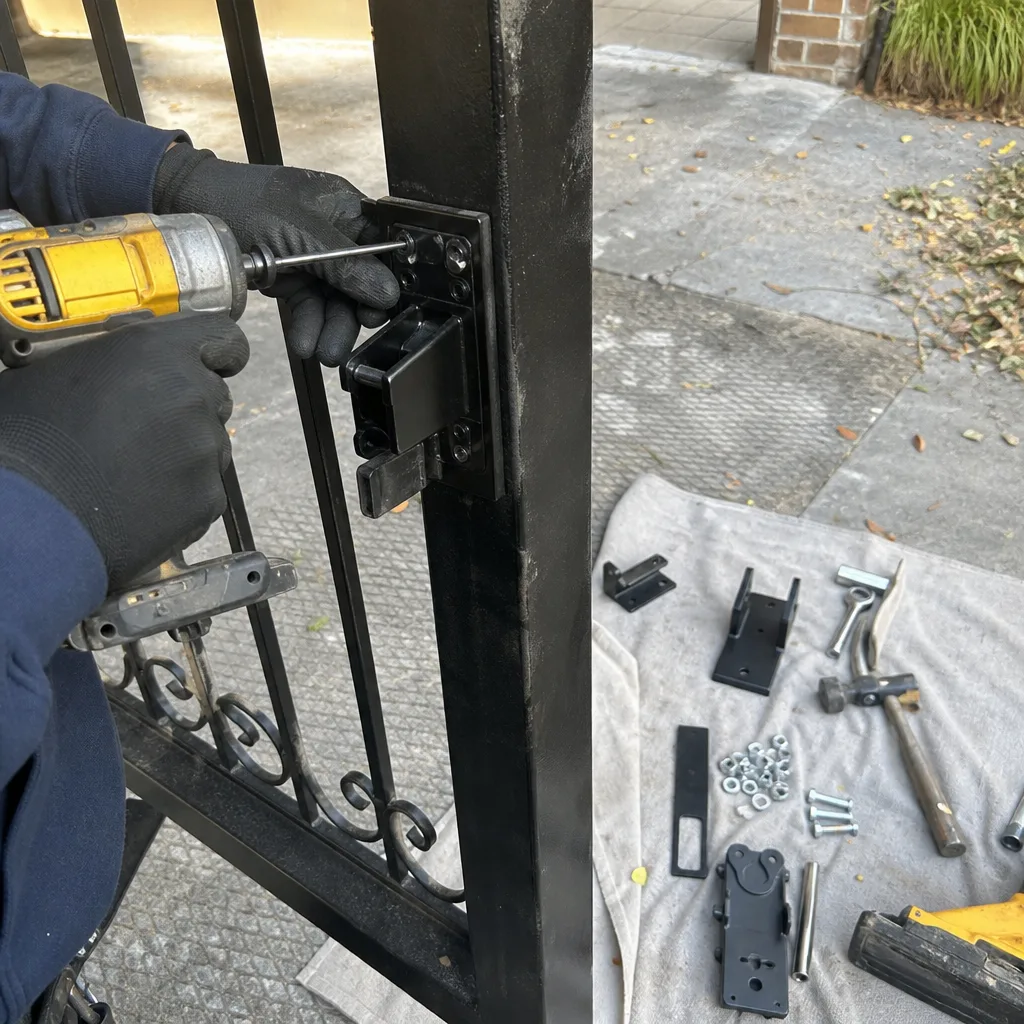
Most gate operators run on either 12V or 24V DC at the motor, fed by a transformer that plugs into a 120V household circuit. The 12V or 24V side is low-voltage and is not regulated by permit in Texas. The 120V side is branch circuit wiring and is regulated. Homeowners routinely misunderstand this and assume that because a gate opener is a consumer product from a big-box store, the wiring is beneath the permit threshold. It is not, once you add a new circuit or extend an existing one.
The distinction, stated plainly:
- No permit: Replacing an operator using the existing outdoor GFCI outlet that was already there. Replacing the low-voltage control wiring between the operator arm and the keypad. Swapping a photo-eye. Replacing the battery in a solar operator. These tasks are no different, electrically, from plugging in a new appliance.
- Permit likely required: Running a new 120V circuit from the breaker panel to the gate location. Installing a dedicated sub-panel for a heavy sliding gate operator. Wiring a 120V keypad pedestal with its own circuit. Any of this is branch circuit work under the National Electrical Code as adopted by most Texas cities, including the electrical code enforced in Murphy. It requires a licensed electrician and an electrical permit.
A good rule of thumb we use in Murphy: if the job involves opening a breaker panel or digging a trench for conduit that carries line voltage, treat it as a permitted electrical job. If it involves a screwdriver, a multimeter, and existing receptacles, treat it as maintenance. Getting this wrong can cause a failed home inspection at sale, a denied reconnection by the utility after an unrelated panel upgrade, or an insurance review that questions the entire electrical history of the property.
Structural Thresholds: Footings, Posts, and Columns
Structural permit triggers for gates are simpler than electrical ones, and they vary by the load the gate places on the ground. The controlling question is whether the work involves a new structural element bearing on the earth. Here is the hierarchy, from least to most regulated:
- Replacing hinges, wheels, rollers, or brackets on an existing post: No permit anywhere in Texas. The structural element has not changed.
- Resetting a leaning post in its existing concrete pier: No permit in most municipalities, including Murphy. This is a repair to an existing foundation, not a new one. The work moves dirt and re-plumbs the post, but it does not create new bearing.
- Setting a new post in a new concrete footing: Permit territory in most Texas cities. The new footing is a structure. Depth, concrete mix, and embedment matter to the inspector, and weather matters to the schedule: in Murphy’s clay soils, a new footing needs to be below the active zone of seasonal shrinkage, which is why local practice often goes deeper than the IRC minimum.
- Building new masonry columns for a driveway gate: Permit territory, full stop. Masonry columns are engineered structures. They have rebar, grout cells, anchor bolts, and wind-load considerations. In Collin County’s flat, storm-exposed terrain, a freestanding column has real overturning force to resist, and no Texas inspector treats it as cosmetic.
The structural permit conversation with the City of Murphy typically involves submitting a simple drawing, specifying the post size and footing depth, and waiting for a field inspection after the concrete is poured but before the gate is hung. The inspection is quick: the inspector confirms the hole depth, the rebar placement if any, and the bolt pattern. In our experience, the entire structural permit cycle for a new gate post in Murphy runs about two weeks from application to final inspection, assuming the contractor is ready.
What Unpermitted Gate Work Does to an Insurance Claim
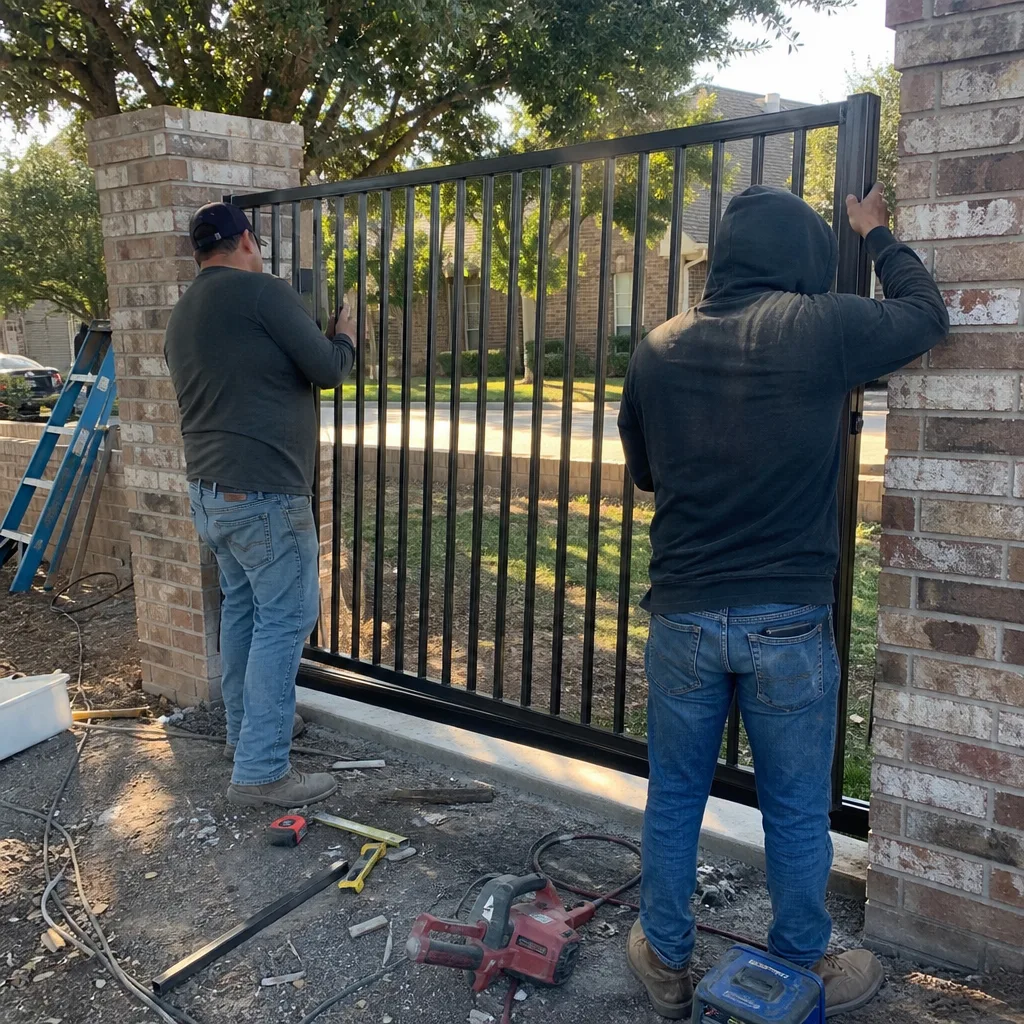
The insurance conversation is the one nobody wants to have until someone is hurt. A gate is a heavy moving object at the edge of a property. When a gate falls on a person or a vehicle and a liability claim follows, the homeowner’s insurance carrier will look at the work history of that gate. What they find matters.
Here is what actually happens in a Texas liability claim involving a gate:
- The adjuster asks for the gate’s service history. If the gate fell because a hinge failed and the repair was done by a licensed contractor with a receipt and photos, the claim proceeds normally. The homeowner has documented maintenance, which most policies expect.
- The adjuster asks whether the work required a permit. If the gate fell because a footer failed, and that footer was new, and no permit was pulled, the carrier will argue the unpermitted work is an excluded cause of loss. They do not always win this argument, but they always make it, and the homeowner is now fighting on two fronts: the injured party and their own insurer.
- The adjuster asks for a receipts trail. Unlicensed, receipt-free gate work is not technically an insurance exclusion in Texas, but it is a coverage defense. The carrier can characterize the homeowner’s failure to maintain the gate as negligence, and the absence of any documented service history supports that characterization.
The protection is documentation, not the permit itself. A permit proves the city reviewed the work. A receipt proves a real contractor did the work. Photos prove the condition of the gate before and after. Together, these three items are the difference between a claim that settles and a claim that spends a year in subrogation. A homeowner in Murphy who replaces a gate operator with a receipt, a copy of the manufacturer’s manual, and a photo of the finished wiring is in an entirely different position than one who paid cash and received a wave goodbye.
How to Document a Repair So It Survives a Future Inspector
Most gate repairs in Texas will never see an inspector. That is not an argument for doing them without a record. It is an argument for creating your own record, because the future buyer’s inspector, the future insurance adjuster, or the future HOA committee will ask a painful question: “Who did this, and what did they do?” Your answer should not be a shrug.
We document every gate job we touch in Murphy the same way commercial access-control work is documented: photos before, photos after, and a written note of what changed. This is the same discipline Adrian Vance developed doing Texas access-control installations starting in 2014, and it carries over to every residential gate. For more guides & resources, visit our blog. Here is the documentation sequence we follow, and that any homeowner can replicate for their own records:
- Photograph the gate before work starts. Full gate from the street side, full gate from the driveway side, close-up of the failure area. These photos establish baseline condition and give the insurance adjuster a “before.”
- Photograph the gate after the work is done. Same three angles, plus a close-up of the new or repaired components. If a hinge plate was replaced, get a photo of the bolt pattern. If a motor was replaced, get a photo of the wiring terminations.
- Write down the part numbers. Not “a new opener.” Write the brand, model, and serial number. For common Murphy gate systems, that might be a LiftMaster LA400 swing arm or a BFT Deimos track operator. Part numbers are far more useful to a future technician than a model name.
- Note the adjustment settings. If limit switches were set, write the settings down. If photo-eye alignment was corrected, note the adjustment. Future troubleshooting becomes dramatically faster when the current settings are known.
- Keep the receipt and a photo of the receipt. Digital copies in two places. Paper receipts for gate work have a way of disappearing into a file drawer and never coming out.
- Attach the HOA approval letter, if one was required. Same for any city permit. These documents are part of the gate’s history, not the house’s history, and they should travel together.
Our team leaves every Murphy customer with this documentation on the same visit. It is not a premium add-on. It is the only way to prove what was done, when, and by whom. A homeowner with a binder of this material can answer any question an inspector, adjuster, or buyer asks. A homeowner without it is relying on memory.
Common Mistakes to Avoid
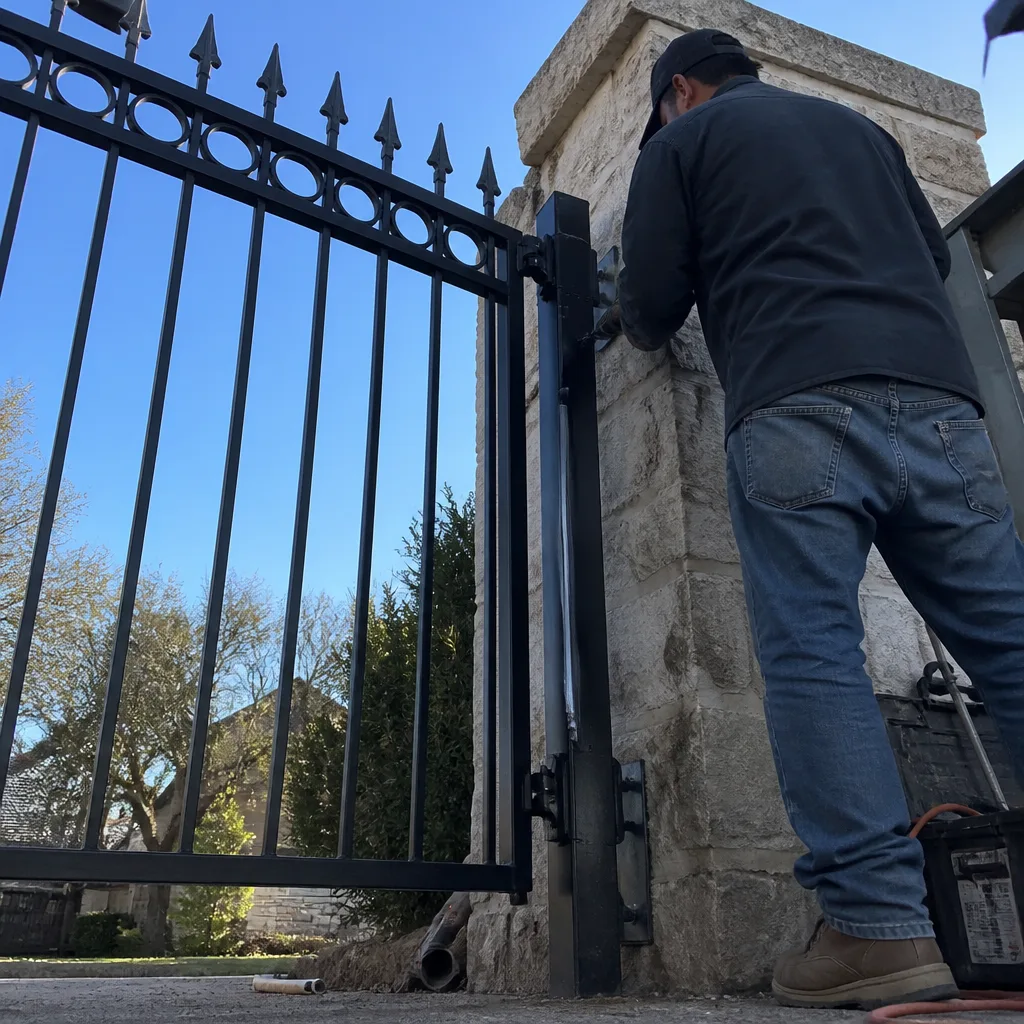
- Assuming “no permit” means “no rules.” Most gate repairs in Texas do not need a city permit, but they still need to be done to manufacturer spec and local electrical code. A repair that is not permitted can still be defective, and a defective repair is still a liability even if no inspector ever saw it.
- Checking with the city but not the HOA. In Murphy, the HOA track and the city track are completely separate. A homeowner who pulls a city permit and skips the HOA approval can end up with a legally permitted gate that the HOA is demanding they remove.
- Skipping the electrical permit on a new operator circuit. The opener itself is low-voltage, but the feed to the transformer is line-voltage. Running that new circuit without a permit is the most common unpermitted gate electrical work we see in Murphy, and it is the one that shows up on home inspections.
- Treating a leaning post as a “straighten it” job when the footing has failed. A post that leans because the concrete pier cracked at grade is not a post problem; it is a footing problem. Re-shimming a failed footing buys a few months and then fails again, usually when the gate is under load.
- Buying a gate operator before checking HOA visibility rules. Some Murphy HOAs restrict the height and placement of operator arms and keypad pedestals. Homeowners who buy first and ask later discover their hardware does not fit the covenant’s appearance standards.
- Paying cash with no receipt for a big gate job. Even if the work is not permit-required, the lack of a receipt hollows out the homeowner’s insurance position and home-sale disclosure. A gate replacement with no trail is a gate that effectively has no history, and the homeowner absorbs the risk of that gap.
- Assuming county rules apply inside the Murphy city limits. Murphy issues its own permits. Collin County does not govern building work inside an incorporated city. Calling the wrong office wastes days, and during a stop-work event, days matter.
When to Call a Professional
Call a licensed, gate-specific contractor when the repair involves structural elements (new footings, post replacement, masonry), when the electrical work touches the breaker panel or runs new conduit, or when the gate is governed by an HOA that requires professional submission drawings. These are the jobs where the cost of a mistake is not measured in dollars but in permit re-checks, failed inspections, and a gate that does not work after the crew leaves. A professional will also know which tasks genuinely need a city inspection in Murphy and which do not, and will not pad the scope to include permits that are not required. Gate repair in Murphy is one of our core services, and Vance Gate Repair Murphy covers the full sequence from permit check to documented finish. For a free estimate in Murphy, call (469) 613-2832.
Frequently Asked Questions
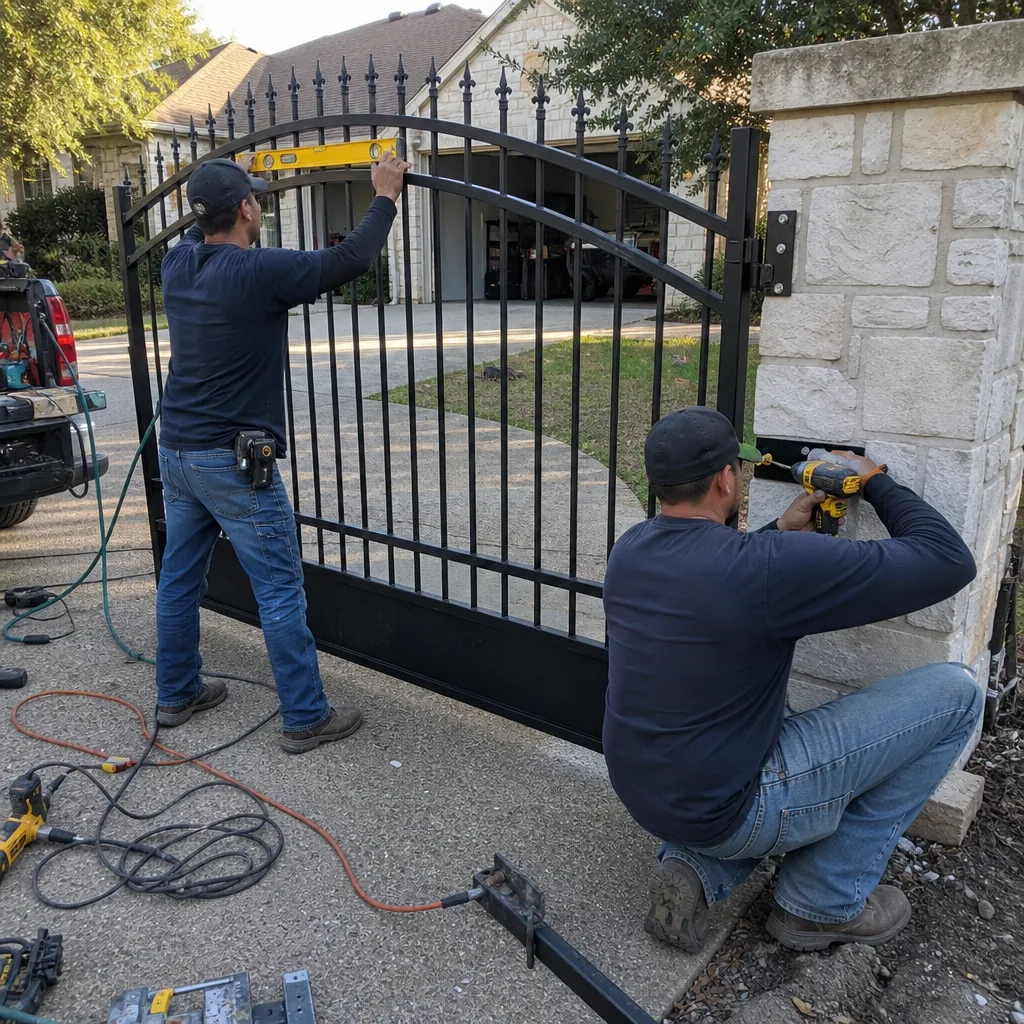
No permit is required for routine gate repair in Murphy, including hinge replacement, track adjustment, sensor realignment, and same-motor operator replacement. A permit is required for new structural footings, post replacement with a new concrete pier, masonry columns, and new 120V branch circuit wiring to the gate. Call the Murphy gate repair team at (469) 613-2832 if you want a definitive answer on your specific scope before any work starts.
Murphy’s residential permit fees for gate-related work are typically modest, in the range of $50 to $200 depending on the trade and valuation, but the exact fee schedule changes and the city publishes the current rates. The permit fee is almost never the expensive part. The inspection cycle and any required corrections are where costs accumulate, and that is exactly what documented pre-work planning avoids.
Repairs that restore the gate to its original, approved appearance generally do not require HOA approval in Murphy. Changes to the gate’s appearance, material, height, or the addition of new visible equipment such as an operator box or keypad pedestal typically do require architectural committee review. Check your covenants before ordering any materials.
Unpermitted gate work can provide your insurer a coverage defense if the gate later fails and injures someone or damages property. The insurer will argue the unpermitted structural or electrical work was an excluded cause, and even when that argument fails, the claim process becomes contested and slow. Documenting the repair with photos, receipts, and part numbers is the most effective protection a homeowner can create, permit or not.
Low-voltage gate work means the 12V or 24V DC circuits between the operator arm, the keypad, the photo-eye, and the battery backup. Replacing or adjusting these components on an existing system does not require an electrical permit in Texas. The line is drawn at the transformer: the 120V AC side that feeds the transformer is branch circuit wiring and is regulated.
Yes, in the sense that we determine which permits are required and coordinate the application and inspection schedule with the City of Murphy whenever the work reaches the permit threshold. We do not pull permits that are not required. The written estimate we provide tells you the truth about which category your job falls into, before any work starts. Call (469) 613-2832 for a free estimate on your specific project.
The Bottom Line
Texas gate repair sits in a gray zone that most people navigate by assumption, and the assumption is usually right until it is not. Routine repair is permit-free. Structural and branch-circuit electrical work is not. The HOA track runs in parallel and requires its own attention. Insurance consequences follow from documentation, not from the permit itself, and a homeowner who keeps a photo-and-receipt trail is protected even on work that never saw an inspector. In Murphy specifically, the city permits desk is the first call, the HOA is the second, and neither one gives a straight answer in writing unless you ask. When the gate work involves footings, masonry, a new circuit, or an HOA visible change, call a professional who knows where the lines are in Murphy. Vance Gate Repair Murphy offers free estimates at (469) 613-2832.
Written by Adrian Vance, Owner at Vance Gate Repair Murphy, serving Murphy since 2014.